What's the best Quizlet alternative? It depends on how you study. For the same flashcards with a free Learn mode, Knowt. For memorising thousands of cards over months, Anki. For flashcards with an AI that writes them, Brainscape or RemNote. And if you'd rather have the quiz and cards built from your own notes, Synt. Seven options compared below.
Quizlet is still the flashcard app everyone knows, but since its best study modes moved behind a subscription, a lot of students are looking elsewhere. This guide compares seven alternatives on the three things that decide it: what you can do for free, what the full plan costs, and which kind of student each one is built for.
Two notes before we start. First, one of the seven is Synt, the app we make. It's in the list because it competes for the same job, and we've tried to be as strict with it as with the others. Second, we checked every price and feature on the official websites and on the US App Store on 24 September 2026, and we link the source each time, because these pages change often.
What Quizlet gives you today
Quizlet's free plan still covers what made it famous: make your own sets, study the ones other people made, and use its practice activities. What's limited is the engine that makes you remember. Quizlet's own help center says free users get Learn mode «for a limited number of rounds per study set», and that the paid Quizlet Plus plan comes with «monthly usage limits» that Plus Unlimited removes.
Quizlet's pricing page blocked our automated check on 24 September, so we can't quote its web prices from today. The US App Store listing shows in-app purchases of $9.99 and $44.99 for Quizlet Plus and $44.99 for Plus Unlimited. Web prices can be lower (when we checked the upgrade page on 18 September it listed Plus at $35.99 a year; see our Knowt vs Quizlet comparison).
Quizlet's strengths are real: a 4.8 rating from about 1.1 million reviews in the US store, an app in 17 languages, and a huge library of shared sets. If those matter most to you, stay. If what you miss is unlimited practice, read on.
The comparison table
| App | Free plan | Paid plan | AI that makes cards or quizzes from your material | Platforms |
|---|---|---|---|---|
| Knowt | Flashcards, unlimited Learn mode, 5M shared resources | Ultra: $24.99/month or $149.99/year | Yes, on Ultra (PDF, video, images, slides) | Web, iOS, Android |
| Anki | Everything on desktop and Android | AnkiMobile for iPhone: $24.99 once | No (manual, add-ons exist) | Windows, Mac, Linux, Android, iOS |
| Brainscape | Unlimited typed cards, AI for «100s» of cards, 2,500 preloaded cards | Pro: $19.99/month or $95.88/year | Yes (unlimited on Pro) | Web, iOS, Android |
| RemNote | Unlimited notes and cards, 3 annotated PDFs, 250 AI credits a month | Pro $8/month or Pro with AI $18/month (billed yearly) | Yes, from text, PDF and slides (Pro with AI) | Desktop, iOS, Android |
| Knowunity | Core tools free | $49.99/year in the US (weekly and monthly options) | Yes, from PDFs, slides, photos, links and YouTube | Web, iOS, Android |
| Vaia (StudySmarter) | Free account with flashcards, notes and study plans | Premium, 7-day free trial | Yes (AI flashcards and summaries) | Web, iOS, Android |
| Synt | Summary, quiz, flashcards and concept map from pasted text, links or photos | €4.99/week, €9.99/month or €29.99/year; PDF and YouTube are Pro | Yes (text, photos; PDF and YouTube on Pro) | Web, iOS, Android |
Now, one by one.
1. Knowt: the one that calls itself the free Quizlet alternative
Knowt says it in the headline of its homepage: «#1 Free Quizlet Alternative». For the basics, it delivers. You can import your Quizlet sets, and its App Store listing promises «unlimited rounds of learn mode» on the free plan, plus matching, spaced repetition and practice tests. The free plan also includes unlimited file creation and access to 5 million shared resources.
The AI costs money. Ultra is $24.99 a month, or $149.99 a year (shown as $12.99 a month billed upfront, with a 3-day trial on the annual plan), and unlocks the PDF, video, image and PowerPoint summarizer, lecture recording summaries, a podcast generator and a voice tutor.
Best for: students who want exactly what Quizlet used to give away. Watch out: the app is English-only, and its exam content is built around AP, SAT and ACT.
2. Anki: the spaced-repetition reference
Anki isn't pretty and has no built-in AI, but it is the reference for long-term memorisation (medicine, languages, bar exams) because its scheduler shows each card again just before you'd forget it. The desktop version is free on Windows, Mac and Linux, and AnkiDroid is free on Android. The only paid piece is AnkiMobile for iPhone, $24.99 once, which funds the project.
Best for: anyone memorising thousands of cards over months who doesn't mind writing them or finding shared decks. If you want an app that writes the cards from your notes, this isn't it.
3. Brainscape: flashcards you rate from 1 to 5
Brainscape is a classic flashcard app with a twist: after each card you rate your confidence from 1 to 5, and its spaced-repetition algorithm decides when to show it again. Its pricing page keeps unlimited typed flashcards, 2,500 preloaded cards and AI for «100s of flashcards» on the free plan. Pro costs $19.99 a month, $95.88 a year ($7.99 a month) or $199.99 once for lifetime access, and adds unlimited AI cards, certified decks, and images and sound on your cards.
Best for: students who want a serious flashcard app with some AI help and don't need summaries or quizzes.
4. RemNote: notes and flashcards in the same document
RemNote combines a note editor with flashcards: you mark a line as a card while you write, without switching screens. Its free plan includes unlimited notes and cards, 3 annotated PDFs and 250 AI credits a month. Pro is $8 a month and «Pro with AI» $18 a month (both billed yearly, $96 and $216), and the AI tier adds flashcards, quizzes and summaries from PDFs, a lecture recorder and AI grading.
Best for: students who already take notes digitally and want the cards to come out of those notes. If that's you, our guide on how to take notes with AI covers the workflow.
5. Knowunity: a notes community with AI on top
Knowunity is above all a community of shared school notes, with an AI tutor, quizzes, mock exams and a day-by-day exam planner built on top. Its US App Store listing says it turns PDFs, slides, photos, links and YouTube videos into flashcards, quizzes and summaries, and adds XP and weekly leagues. The core tools are free; Knowunity Pro costs $49.99 a year in the US, with weekly and monthly options.
Best for: high-school students who want other students' notes and an AI to ask. If you're at university, the library will help less. We compare it in more detail in Knowunity alternatives.
6. Vaia (StudySmarter): a study platform with an AI assistant
Vaia, from the team behind StudySmarter, offers a free account with flashcards, notes, study plans and AI features, and a Premium plan with a 7-day free trial. According to its help center, Premium adds an ad-free experience, offline flashcards, unlimited learning sets and unlimited use of the AI assistant chat. We couldn't find a public price page; the US App Store lists several annual Premium price points, so check the price in the app before you commit.
Best for: students who want an all-in-one platform with a chat assistant, in English, French, German or Spanish.
7. Synt: from your notes to the exam, not just flashcards
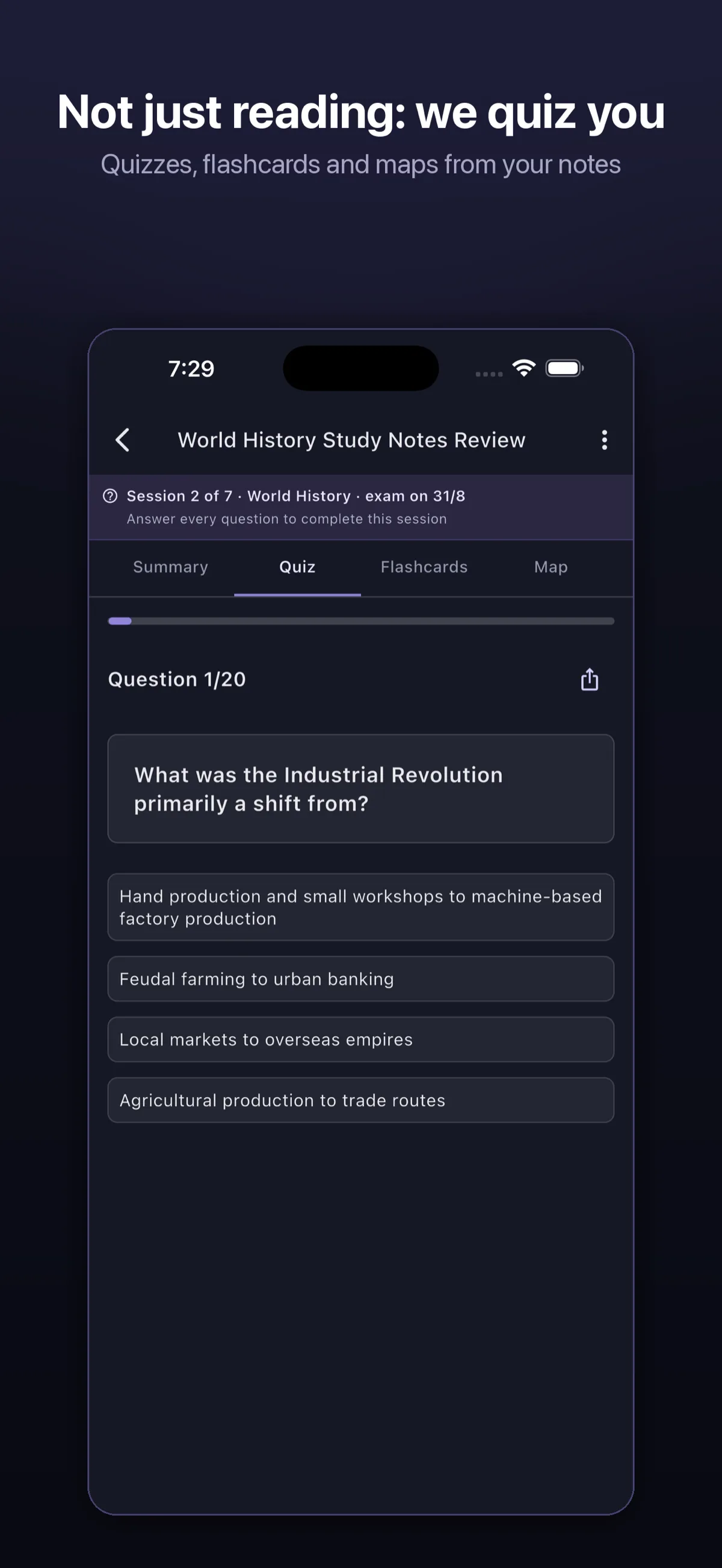
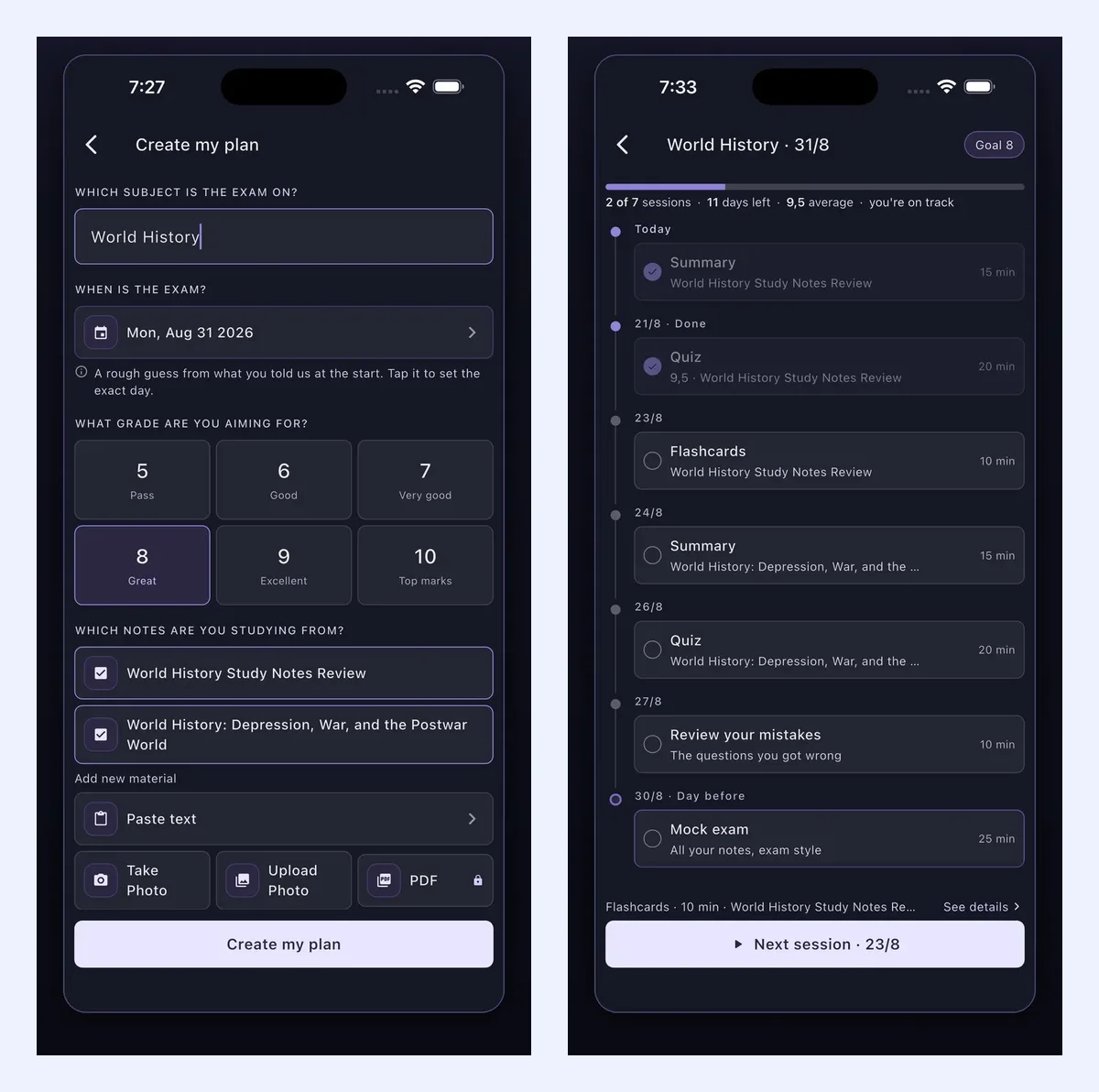
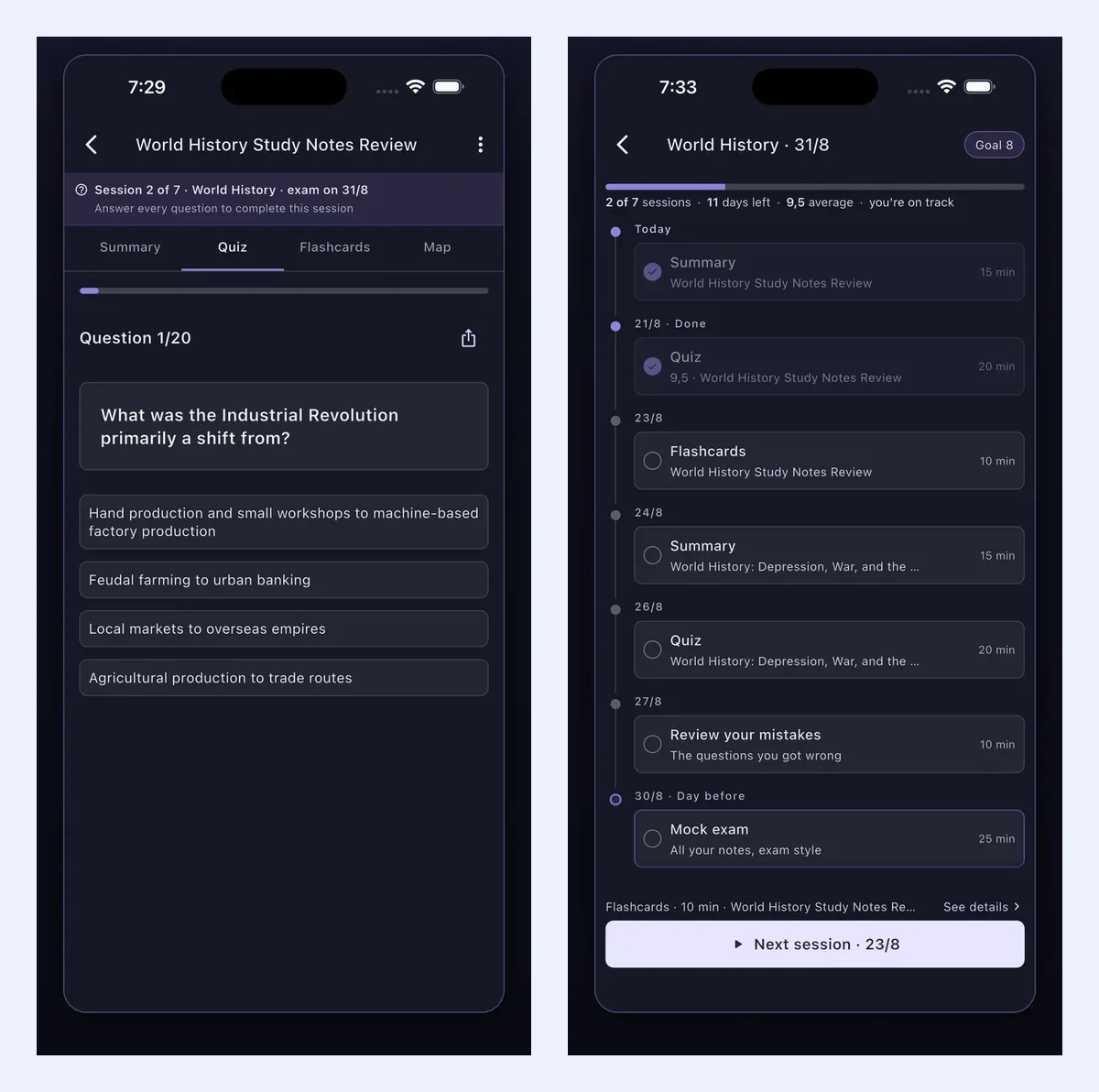
This is ours. The difference between Synt and a flashcard app is the starting point: you don't make cards. You paste your notes, add a link or upload photos of your pages, and Synt generates a summary, a quiz, flashcards and a concept map from that material only. You can also set your exam date and target grade, and it plans short sessions up to that day, with a review of the questions you got wrong and a mock exam the day before.
On the web, the free plan covers pasted text, links and photos of your notes. PDF upload and YouTube videos are Pro, at €4.99 a week, €9.99 a month or €29.99 a year with a 3-day trial, and one subscription works on web and mobile. App Store prices are set per country.
Best for: students who study from their own notes or a syllabus and want the questions to come from that material, not from a public library. If you prefer the classic «shuffle the deck for months» method, Anki or Knowt do it better. You can try the notes to quiz tool without an account.
How to choose: three questions
Do you want cards, or do you want to learn a topic? If your method is a deck of flashcards, Anki (free on desktop and Android) or Knowt (free with unlimited Learn) are the natural Quizlet replacements. If what you have is a syllabus and a date, an app that turns your notes into a summary, quiz and flashcards saves you the step of writing the cards.
What language do you study in? Knowt, Brainscape and RemNote are English-only apps. Quizlet (17 languages), Knowunity (16), Synt (7) and Vaia (4) are available in more.
How long will you use it? For a week of revision, almost any free plan will do. For a whole year, compare the annual price: $49.99 for Knowunity Pro in the US, $95.88 for Brainscape Pro, $149.99 for Knowt Ultra, €29.99 for Synt Pro.
Whichever you pick, the method matters more than the app. Flashcards work because they force you to retrieve the answer instead of re-reading it, which is the whole idea behind active recall and spaced repetition. For the weeks before an exam, a plan does more than any feature; we wrote up how to study for exams.
If you want to see your own notes turned into a quiz before deciding, paste a page into Synt and compare it with what you get from Quizlet. It's the quickest way to find out which one fits.