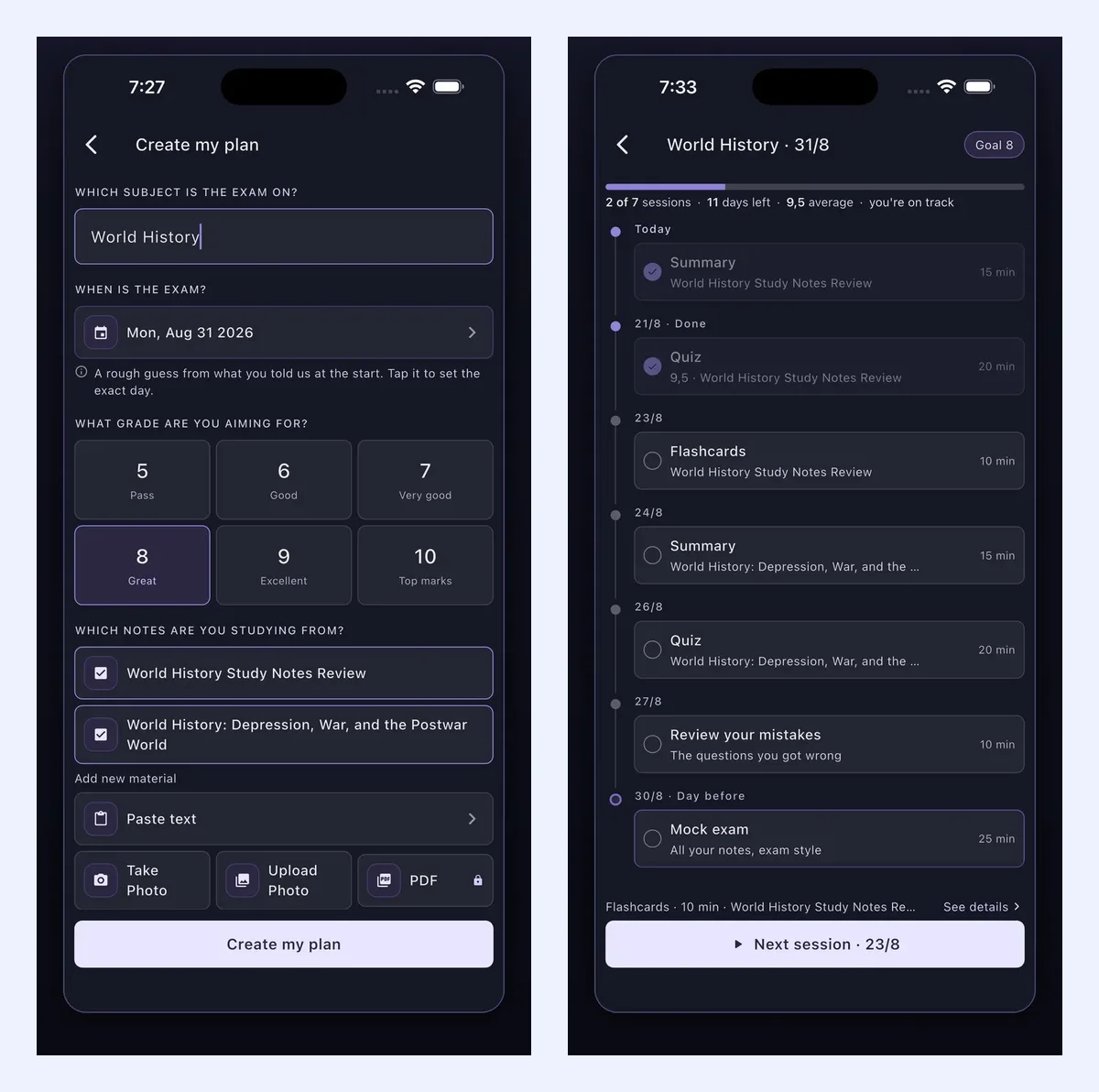
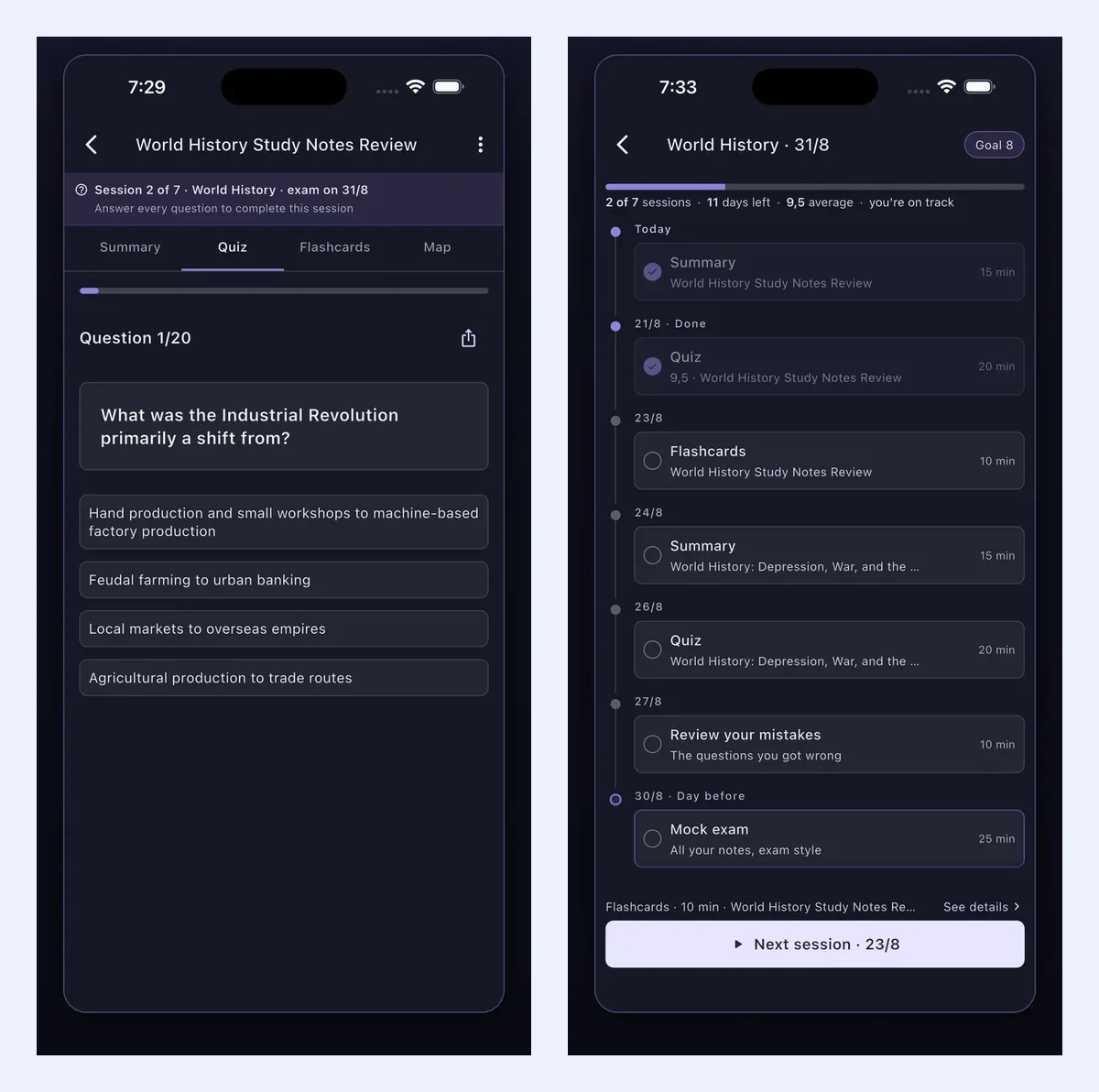
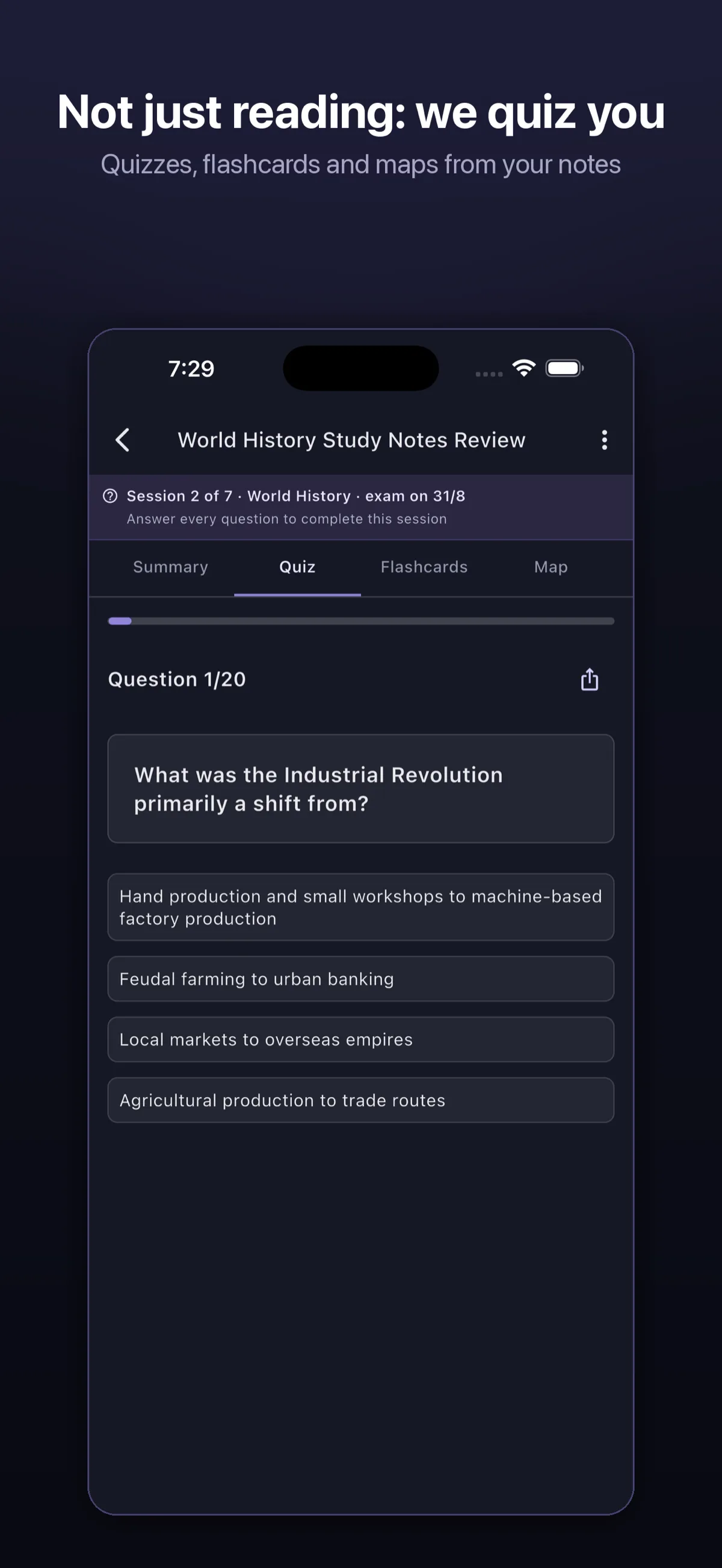
Most exam preparation fails before it starts — not because students don't work hard, but because the work is scheduled backwards. The typical pattern is light reading for weeks, then a panicked cramming marathon in the final 48 hours. That order is almost perfectly wrong: cramming loads information into short-term memory just in time for it to evaporate.
This guide flips that pattern into a plan you can actually follow. It's built on the two most heavily evidenced techniques in learning science — active recall and spaced repetition, the only two of ten techniques rated "high utility" in the Dunlosky et al. (2013) review — and it's organized week by week, so you always know what today's session is for.
Why Do Most Exam Study Plans Fail?
Three reasons come up again and again:
- Passive review feels like progress. Re-reading chapters and highlighting create familiarity, not recall. On exam day, familiarity is worthless — you need retrieval. Roediger and Karpicke (2006) showed exactly this: students who re-read were more confident than those who tested themselves, and remembered less a week later.
- Everything is scheduled by topic, nothing by memory. Studying a topic once, however thoroughly, guarantees you'll forget most of it within days unless you return to it on a schedule.
- Practice testing starts too late. Most students meet exam-style questions for the first time in the exam. The single highest-yield activity — answering questions under realistic conditions — gets pushed to the end, if it happens at all.
The plan below fixes all three by making retrieval the default activity from day one.
How to Study for Exams: A Week-by-Week Plan
Three to four weeks out — Map the territory
Your goal this week is not to learn anything yet. It's to know exactly what the exam can ask.
- Collect the syllabus, past papers, and lecture notes into one place.
- Build a topic list — every examinable concept, one line each. This list becomes your progress tracker.
- Condense your materials. Turn each lecture or chapter into a one-page summary you'll revise from. This is where an AI tool earns its keep: Synt can summarize a PDF or a photo of your notes in seconds, so you spend your energy on learning, not transcribing. If you take notes by hand, the Cornell note-taking system produces summaries almost as a side effect.
- Rate each topic red / amber / green for confidence. Reds get double time in the schedule.
Two weeks out — Learn actively, topic by topic
Now work through your topic list, spending most of each session in retrieval mode, not reading mode:
- Read the summary once, close it, and write down everything you remember. Then check what you missed. That gap is your real to-do list.
- Turn each topic into questions. Flashcards work well for definitions and facts; practice questions work better for reasoning. Synt generates quizzes and flashcards directly from your own summaries, which keeps the questions anchored to your actual course material.
- For concepts you can't explain simply, run a Feynman Technique cycle: write an explanation for a beginner, find where it breaks, and go fix exactly that.
Schedule first revisits of early topics during this week too — a topic studied on Monday should be quizzed again by Thursday. That's spaced repetition beginning to work for you.
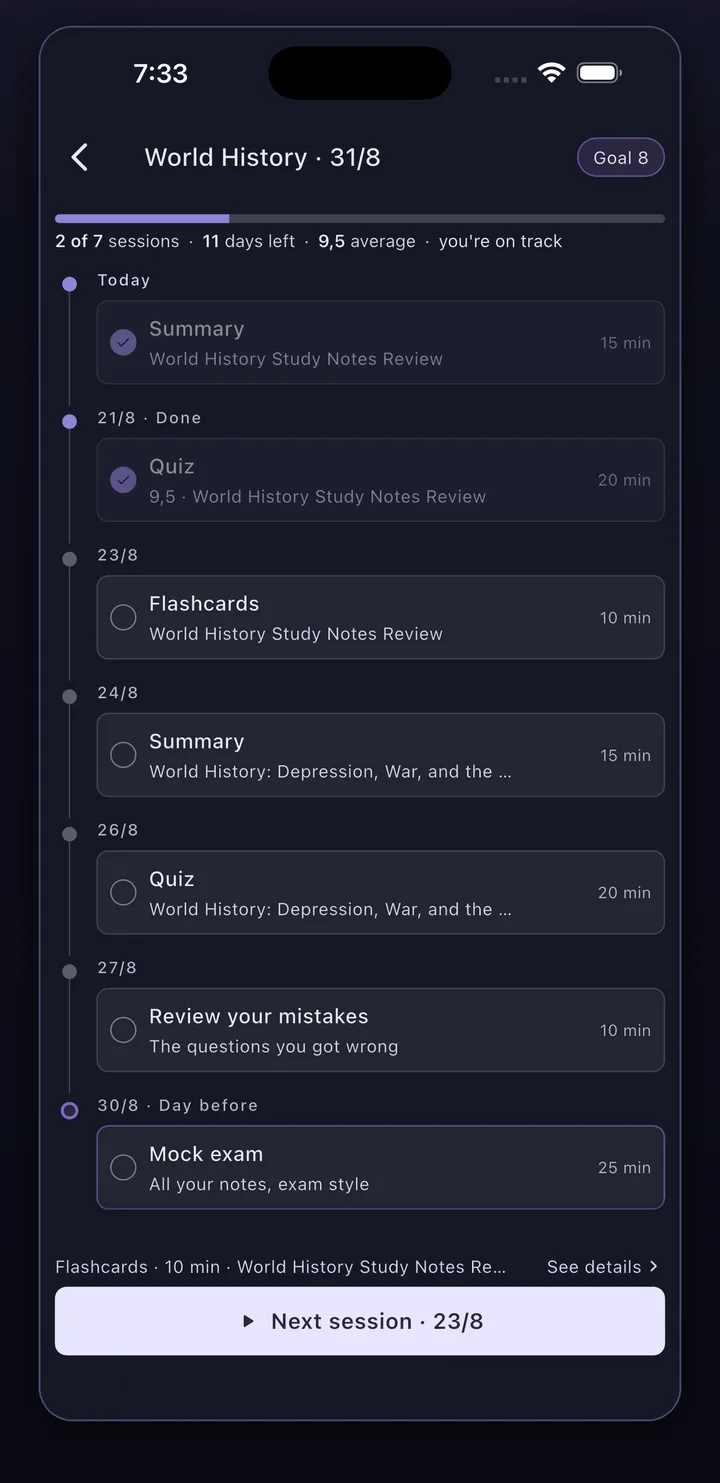
If you'd rather not build the timetable by hand, Synt does it for you: give it the exam date and the grade you're aiming for and it schedules summary, quiz, flashcard and review sessions up to the day of the exam.
One week out — The final seven days, day by day
This is the week most students burn on re-reading. Use it for testing instead:
- Day 7 — Full pass, weak spots first. Quiz yourself across every red topic. Update your red/amber/green ratings honestly.
- Day 6 — Past paper under exam conditions. Timed, no notes. Mark it. The score doesn't matter; the error list does.
- Day 5 — Repair day. Work only on what the past paper exposed. Rewrite summaries where your understanding was wrong, not just incomplete.
- Day 4 — Second past paper. Compare error patterns with Day 6. Recurring mistakes get a Feynman cycle each.
- Day 3 — Spaced review of everything green and amber. Fast flashcard runs; you're maintaining, not learning.
- Day 2 — Light retrieval only. One final quiz pass on reds. Stop by early evening. Sleep is a memory consolidation tool, not a luxury.
- Day 1 — Exam day. A short warm-up recall session in the morning (10–15 minutes, no new material), then close the books.
How Long Should Each Study Session Be?
Shorter and more frequent beats longer and rarer, because each session that begins with recall is a spaced repetition event. A practical default: 45–50 minutes of focused work, 10-minute break, repeat — two to four blocks per day depending on how many exams you're juggling. If staying on task is the real problem, fix the environment first: our guide on how to focus while studying covers the setup that makes these blocks actually focused.
What Should You Do the Night Before an Exam?
Less than you think. The two highest-value actions are a short retrieval run over your weakest topics and a full night of sleep. Memory consolidation happens during sleep (Walker & Stickgold, 2004); trading it for three extra hours of anxious re-reading is a net loss. Prepare your materials for the morning, do one calm flashcard pass, and stop.
Common Exam Preparation Mistakes to Avoid
Studying by re-reading. Recognition is not recall. If your plan is "go through the notes again," you don't have a plan — you have a ritual.
Making materials instead of using them. Beautiful summaries and color-coded flashcards are only inputs. The learning happens when you test yourself with them. Automate the making (this is exactly what Synt is for) and spend the saved hours on retrieval.
Studying topics once. One pass creates the illusion of coverage. Without scheduled returns, the forgetting curve quietly deletes your work.
Ignoring past papers. The exam is a performance format. Practicing content without practicing the format is like rehearsing a play by reading the script silently.
All-nighters. Sleep deprivation measurably cuts recall the next day. It is the single most self-defeating exam habit.
Putting the Exam Study Plan to Work
You don't need to follow this plan perfectly. The core is portable to any timetable: condense your materials early, convert them into questions, test yourself on a spacing schedule, and rehearse the exam format before it counts. Even applying half of it puts you ahead of a cramming schedule.
Want the tedious parts done for you? Synt turns your lecture notes, PDFs, and photos into summaries, then generates the quizzes and flashcards this plan runs on — so your study time goes to remembering, not preparing to remember.